



Is Lehigh Valley a good place to live? For many people, the answer is yes, but perhaps not for the reason you expect.
The Lehigh Valley is sometimes described as a quieter, less expensive alternative to New York City, North Jersey, or Philadelphia. That description misses the point. This is not simply a place to settle for less. It is a region where historic downtowns, established suburbs, major employers, colleges, hospitals, trails, entertainment, and close-knit communities exist within the same connected area.
Still, choosing to move here deserves more than a glowing list of attractions. You need to know whether the housing, commute, pace of life, and individual communities fit the way you actually want to live.
As a local real estate professional, I help people look beyond listing photos and online rankings. My goal is to help you understand what daily life could feel like here, identify the communities that fit your priorities, and make a decision you will still feel good about years from now.
The Lehigh Valley is a good place to live for people who want access to jobs, recreation, culture, and varied housing without living in the middle of a major East Coast city.
The region combines three distinct urban centers, Allentown, Bethlehem, and Easton, with smaller boroughs, suburban communities, and more rural areas. That variety is one of its greatest strengths. You can enjoy an active downtown lifestyle, seek a traditional neighborhood, or look for more space without necessarily leaving the region.
The biggest mistake is assuming that every part of the Valley offers the same experience. It does not.
Your ideal location will depend on questions such as:
- Do you want a walkable downtown or a quieter residential street?
- Will you commute locally, work remotely, or travel toward New Jersey?
- Do you prefer an older home with character or newer construction?
- How important are nearby restaurants, parks, hospitals, and entertainment?
- What total monthly housing cost feels comfortable?
The core message is simple: the Lehigh Valley can offer an excellent quality of life, but the right community matters as much as the right house.
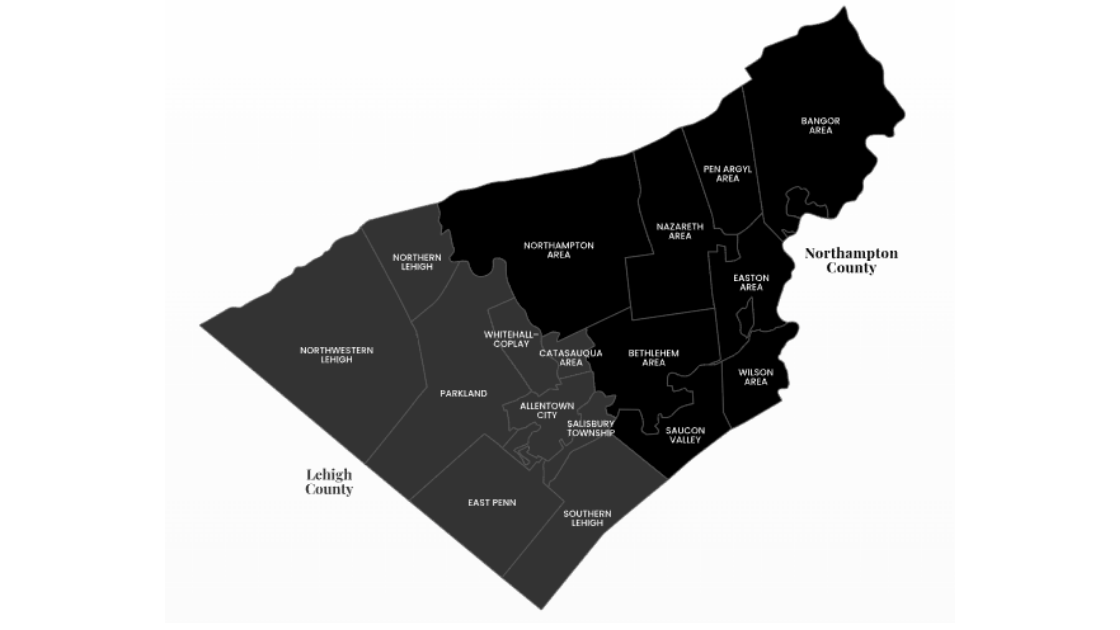
The Lehigh Valley is an eastern Pennsylvania region centered around Allentown, Bethlehem, and Easton, with numerous surrounding boroughs and townships.
The metropolitan area extends across Lehigh and Northampton counties and into parts of New Jersey for federal statistical purposes. Allentown is the largest city, while Bethlehem and Easton each offer their own distinct identities.
Well-known communities throughout the area include:
- Allentown
- Bethlehem
- Easton
- Emmaus
- Macungie
- Hellertown
- Nazareth
- Whitehall
- Catasauqua
- Coopersburg
- Fogelsville
- Saucon Valley
- Palmer Township
- Lower Macungie Township
This variety means “moving to the Lehigh Valley” could describe very different lifestyles. A home near downtown Bethlehem will not feel the same as one in Lower Macungie, Nazareth, or a more rural township.
That is good news. You are not trying to decide whether one single town fits you. You are choosing from an entire collection of communities.
The biggest advantages are location, lifestyle variety, employment access, recreation, culture, and a strong sense of community.
You can enjoy the practical benefits of a populated region without feeling surrounded by skyscrapers and congestion every day. Depending on where you live, daily life might include a walk through a historic downtown, dinner at an independent restaurant, a minor-league game, a trail ride, or a quiet evening in a suburban neighborhood.
Key benefits include:
- Three distinct cities: Allentown, Bethlehem, and Easton provide different dining, entertainment, employment, and housing options.
- Outdoor recreation: The region offers parks, walking and biking trails, canal paths, and access to nearby mountain recreation.
- Arts and culture: Residents can visit museums, music venues, festivals, theaters, and historic sites.
- Employment diversity: Healthcare, manufacturing, education, transportation, logistics, and professional services all contribute to the regional economy.
- Regional access: New Jersey, Philadelphia, the Poconos, and New York City are within reach, depending on traffic and your starting point.
- Housing variety: Buyers can explore row homes, historic properties, suburban developments, condominiums, townhomes, and larger rural lots.
Discover Lehigh Valley highlights restaurants, breweries, live music, hiking trails, museums, festivals, and attractions throughout the region. Easton alone offers the State Theatre, Karl Stirner Arts Trail, Crayola Experience, and other family and cultural destinations.
And here is where an old belief deserves to disappear: You do not have to choose between an interesting life and a comfortable home base. In the right Lehigh Valley community, you may be able to build both.
The main drawbacks include rising housing costs, property-tax differences, traffic, car dependence, winter weather, and the difficulty of commuting daily to a distant city.
No community is perfect, and pretending otherwise does not help you make a smart move.
Housing affordability has become a genuine concern. Local reporting found that Lehigh Valley housing costs continued rising in 2025, with average regional rent reaching approximately $1,778 at the end of that year.
Other tradeoffs include:
- Competitive homes can move quickly. Attractive properties in popular locations may receive strong interest.
- Taxes vary by municipality and school district. Two similarly priced homes can produce different monthly costs.
- A car is often necessary. Some downtown areas are walkable, but many errands and commutes require driving.
- Traffic can be frustrating. Major corridors become busy during peak hours.
- Winters require preparation. Snow, ice, cold temperatures, and early sunsets are part of living in eastern Pennsylvania.
- Older homes may require maintenance. Historic character is appealing, but it can come with aging systems or renovation needs.
Most buyers worry that discovering drawbacks will ruin their excitement. In reality, understanding them creates confidence. A challenge you can plan for is far less stressful than a surprise you discover after closing.
The Lehigh Valley can be more affordable than some nearby metropolitan markets, but it should not be treated as universally inexpensive.
Affordability depends on what you are comparing, where you choose to live, and what type of property you need. Someone relocating from Manhattan may view the region differently from someone moving within Pennsylvania.
A responsible comparison should include more than the asking price:
- Mortgage principal and interest
- Property taxes
- Homeowners insurance
- Utilities
- Commuting costs and tolls
- Maintenance or association fees
- Expected repairs and improvements
That last point changes the conversation. A lower-priced older home may need significant work, while a newer property may carry a homeowners association fee or higher purchase price.
The least expensive property is not always the most affordable home. The better goal is finding a home that supports your life without creating constant financial pressure.

The Lehigh Valley has a diversified employment base that includes healthcare, education, manufacturing, logistics, management, and professional occupations.
The U.S. Bureau of Labor Statistics reported that the Allentown-Bethlehem-Easton metropolitan area had a mean hourly wage of $30.81 in May 2025. Higher-paying occupational groups included management, healthcare practitioners and technical roles, and legal occupations.
Major healthcare networks, colleges, industrial employers, warehouses, small businesses, and corporate operations support the regional economy. The mix matters because it means the Valley is not dependent on one single downtown or industry.
Of course, your experience will depend on your field. Before moving, compare available positions, compensation, commute times, and remote-work flexibility. A promising salary can feel very different once tolls, fuel, parking, and travel time are added.
You can travel from the Lehigh Valley to New York City or Philadelphia, but a daily commute may be tiring, costly, and highly dependent on traffic and schedules.
This is where a map can create a dangerous illusion. A destination may look close enough geographically, but that does not mean the trip will feel easy at 6:30 on a rainy Tuesday morning.
Trans-Bridge Lines operates bus service between Allentown and New York, while other carriers provide varying service from regional locations. The available options and times may not suit every traditional commuter schedule.
There is also no active passenger rail connection directly linking the Lehigh Valley with New York City or Philadelphia as of this writing. Proposed rail service remains a planning topic rather than a transportation option residents can currently use.
A hybrid commute may be manageable for some people. A five-day-per-week commute could feel entirely different.
Before buying, test the trip:
- Leave at the time you would normally commute.
- Make the return journey during rush hour.
- Calculate tolls, parking, fuel, and fares.
- Repeat the test on more than one weekday.
- Consider what happens during snow, accidents, or schedule changes.
You are not just purchasing a home. You are purchasing the routine attached to it.
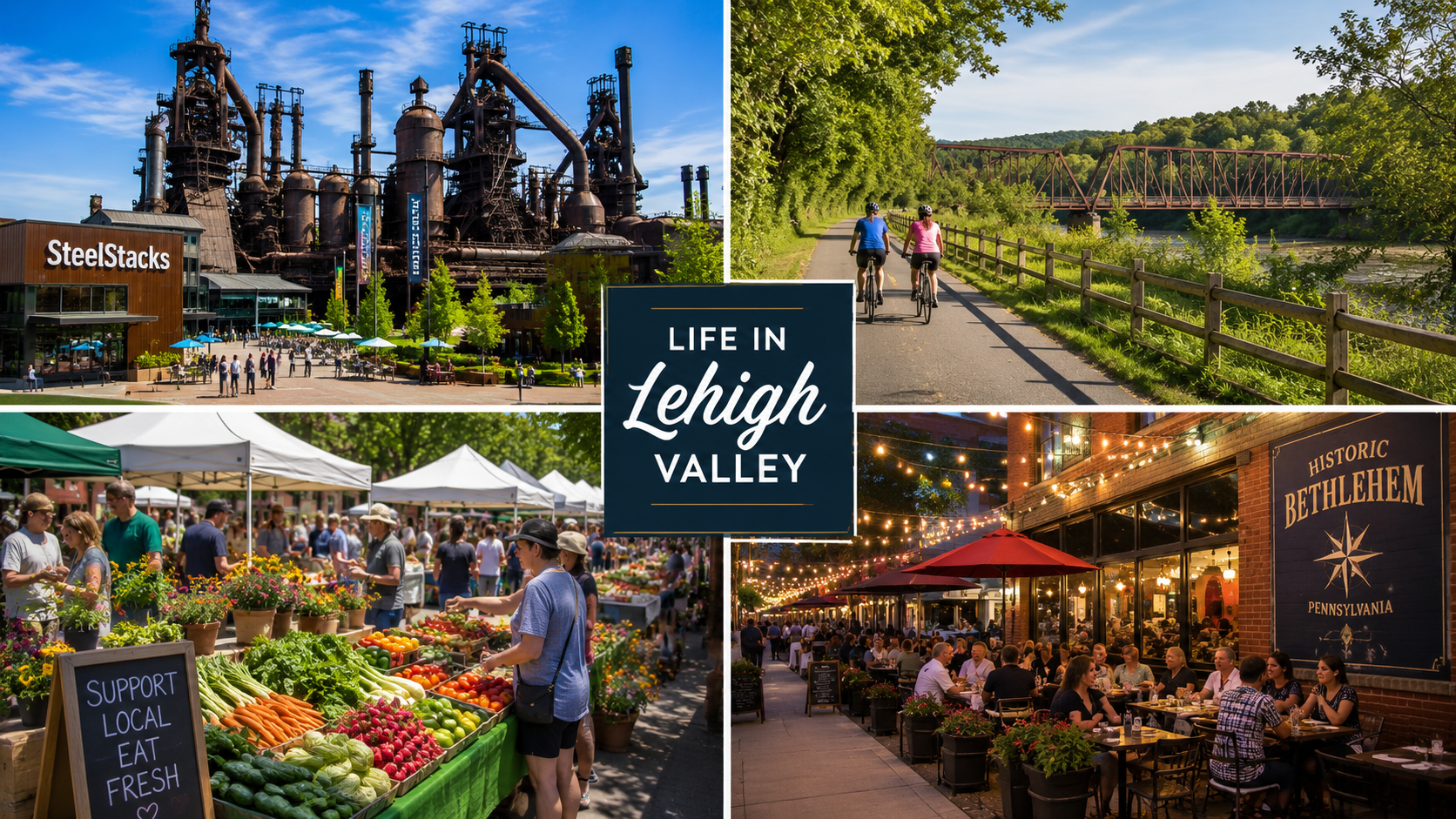
The Lehigh Valley offers year-round entertainment, dining, arts, history, sports, and outdoor recreation.
Bethlehem blends its industrial heritage with destinations such as SteelStacks and the National Museum of Industrial History. Easton offers restaurants, a riverfront setting, the State Theatre, an arts trail, and family attractions. Allentown adds museums, sports, entertainment venues, dining, and urban amenities.
Discover Lehigh Valley identifies more than 20 museums across the region, including America on Wheels, the National Canal Museum, and the National Museum of Industrial History.
Depending on your interests, you might spend a weekend:
- Walking through a farmers market
- Attending Musikfest or another seasonal event
- Exploring a canal or arts trail
- Watching a baseball or hockey game
- Visiting a museum
- Hiking or biking
- Discovering a new restaurant
- Taking a day trip to the Poconos
The dream is not constant excitement. It is having options when you want them and a comfortable place to return to afterward.
The best Lehigh Valley community is the one that aligns with your commute, budget, preferred surroundings, housing style, and daily priorities.
Here is a general starting point:
Allentown
Allentown may appeal to buyers who want urban amenities, employment access, entertainment, diverse housing, and proximity to major roadways. Different neighborhoods offer different experiences, so block-level research matters.
Bethlehem
Bethlehem may fit buyers who appreciate historic character, cultural events, restaurants, colleges, walkable areas, and a lively community calendar. Its north and south sides also provide noticeably different surroundings and housing choices.
Easton
Easton may attract people who enjoy a smaller urban center, riverfront character, an active downtown, restaurants, arts, and access toward New Jersey. The broader Easton area includes suburban township options as well.
Emmaus and Macungie
These communities may appeal to buyers seeking a small-town or suburban atmosphere while remaining close to employment centers, shopping, and major routes.
Hellertown and Saucon Valley
This area offers proximity to Bethlehem with a smaller-community feel and access to both established neighborhoods and more spacious properties.
Nazareth and surrounding townships
Nazareth and nearby areas may suit buyers who want a quieter environment, community traditions, and a range of suburban or less densely developed settings.
These are not rigid labels. Every community contains nuances that an online summary cannot capture. Visit at different times, walk the streets, test the drive, and pay attention to how the area makes you feel.
The Lehigh Valley can work well for families, professionals, and retirees, but each group should evaluate the region through a different lens.
Families may prioritize housing layout, parks, childcare, school information, activities, and proximity to relatives. Professionals may care more about commuting, internet access, restaurants, networking, airports, or a home office. Retirees might focus on healthcare, property upkeep, one-floor living, taxes, and access to social or recreational activities.
Healthcare is an important regional strength, and the Valley also offers numerous colleges, cultural institutions, and community organizations.
When evaluating schools, use objective sources and your own priorities rather than relying on someone else’s definition of “best.” Review district information, programs, transportation, boundaries, and resources directly.
A good community is not determined by a label. It is determined by how well it supports your real life.
An AI-Certified real estate agent can use modern tools to organize information, streamline communication, improve property marketing, and save you time without replacing personal guidance.
Technology is most helpful when it makes a complicated process feel clearer.
I can use AI-supported tools to help:
- Organize property options around your stated priorities
- Compare homes and community features more efficiently
- Create clear summaries of information you need to review
- Improve communication and follow-up
- Build stronger, more targeted marketing materials for listings
- Reduce time spent on repetitive administrative tasks
AI does not walk through a neighborhood and notice how the traffic sounds. It does not understand the emotional weight of moving closer to family. It does not replace negotiation skill, ethical responsibility, local context, or human judgment.
The advantage comes from combining efficient technology with personal service and real estate expertise. That is the standard I bring to every client relationship. This client-focused approach reflects the recommended way to explain AI certification in practical, trustworthy terms.
Decide whether the Lehigh Valley is right for you by testing your desired lifestyle against the region’s housing, costs, communities, and transportation realities.
Use this six-step process:
- Define your ideal day. Consider work, errands, recreation, family time, and commuting.
- Set a complete housing budget. Include taxes, utilities, insurance, travel, and maintenance.
- Choose several communities to compare. Do not make a decision based on one city or online ranking.
- Visit at realistic times. Explore during the week, at night, and during rush hour.
- Tour different housing types. Compare older homes, newer construction, townhomes, condominiums, and suburban properties.
- Ask for local guidance. A knowledgeable agent can help you identify questions you may not know to ask.
Imagine waking up in a home that fits, following a routine that feels sustainable, and knowing you chose the community intentionally. That outcome does not come from chasing the most impressive listing. It comes from making the right match.
The Lehigh Valley is worth serious consideration if you want community variety, regional employment, cultural attractions, outdoor recreation, and access to larger East Coast destinations.
It is not a perfect fit for everyone. Daily long-distance commuters, buyers expecting extremely low housing costs, or people who want comprehensive rail transportation may need to weigh the tradeoffs carefully.
For many others, the region offers something increasingly valuable: room to build a full life. You can find career opportunities, historic places, local traditions, restaurants, trails, entertainment, and neighborhoods that feel personal rather than anonymous.
The question is not simply, “Is Lehigh Valley a good place to live?”
The better question is, “Which part of the Lehigh Valley will help me live the way I want?”
Thinking about making the Lehigh Valley your next home? Contact me for expert advice tailored to your budget, commute, lifestyle, and real estate goals. Together, we can identify the community that feels right before you make your move.
A confident move begins with one clear conversation. Contact me today, and let’s turn uncertainty into a practical plan.
Is the Lehigh Valley expensive to live in?
The Lehigh Valley is not uniformly inexpensive, and housing costs have increased in recent years. Your total cost will vary by municipality, property taxes, home type, commute, and maintenance needs. Compare complete monthly expenses rather than purchase prices alone.
What are the best places to live in the Lehigh Valley?
The best place depends on your lifestyle. Bethlehem and Easton may appeal to people who value historic, active downtowns, while communities such as Emmaus, Macungie, Nazareth, and surrounding townships may offer a more suburban or small-town experience. A personalized comparison is more useful than a universal ranking.
Is the Lehigh Valley a good place for families?
The Lehigh Valley can be a strong option for families because it offers varied housing, parks, healthcare, museums, activities, and different community settings. School districts and programs vary, so families should review objective information based on their individual needs. Visiting neighborhoods in person is also essential.
Can you live in the Lehigh Valley and commute to New York City?
Yes, some residents commute or travel regularly to New York City, especially under hybrid schedules. Bus options are available, but there is no active direct passenger rail service from the Valley, and daily travel can be long and expensive. Test the commute before committing to a home.
What should I know before moving to the Lehigh Valley?
Research property taxes, commute times, winter conditions, home maintenance, municipal services, and differences between communities. Visit several areas at multiple times of day. Most importantly, choose based on your daily life rather than a city’s reputation alone.
- Moving to Lehigh Valley” → Link to a Lehigh Valley relocation guide
- “Choosing where to live” → Link to a community comparison or neighborhood guide
- “Buying a home in Lehigh Valley” → Link to a local homebuyer guide
- “Historic Bethlehem” → Link to a Bethlehem community page
- “Contact me for expert advice” → Link to the agent’s contact or consultation page
- https://www.discoverlehighvalley.com/things-to-do/
- https://www.discoverlehighvalley.com/things-to-do/things-to-do-with-kids/
- https://www.trexlernaturepreserve.org/
- https://www.discoverlehighvalley.com/directory/trexler-nature-preserve/
- https://www.discoverlehighvalley.com/things-to-do/attractions/steelstacks/
- https://www.nmih.org/
- https://www.discoverlehighvalley.com/cities-towns/bethlehem/things-to-do/
- https://www.discoverlehighvalley.com/blog/save-with-budget-friendly-activities-in-lehigh-valley/
- https://www.discoverlehighvalley.com/events/
- https://www.discoverlehighvalley.com/events/events-this-weekend/
Check out this article next